From black box to platform plugins: lessons from the Lawtomation Days in Madrid

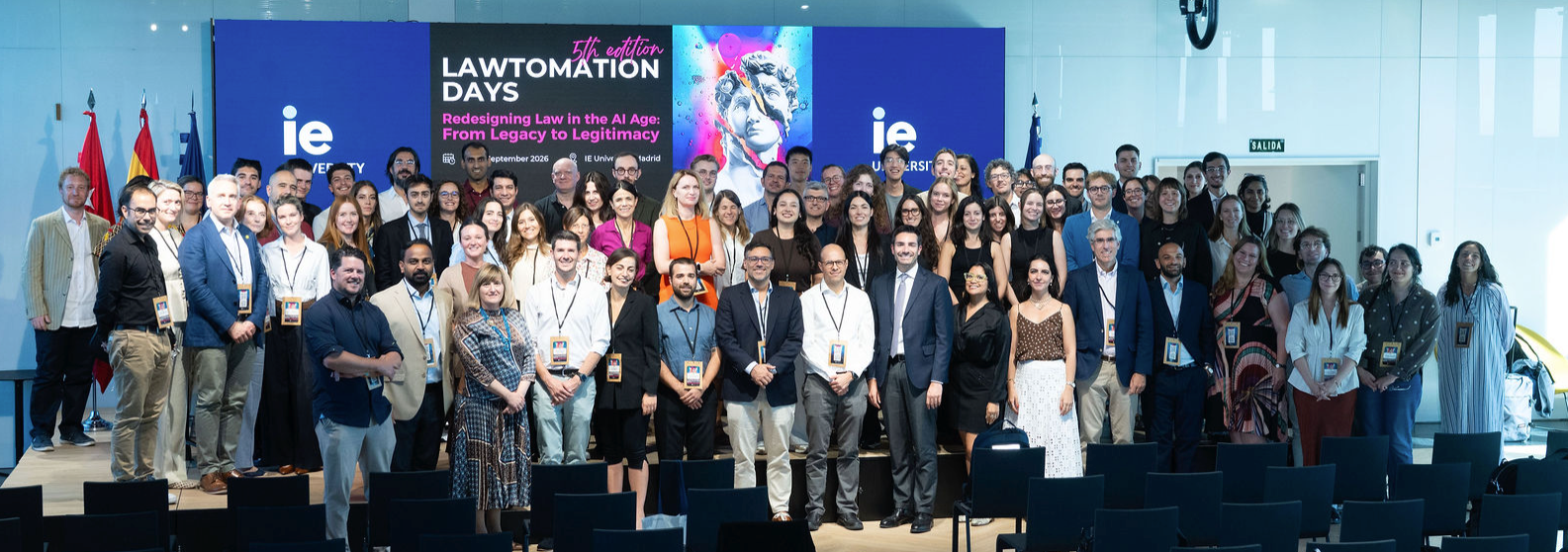
Last week, the fifth edition of the IE Lawtomation Days took place in Madrid. A conference that not only discusses ‘law’ and ‘automation’, but also explores “whether better-designed and more effectively enforced laws might achieve more”. I always find it interesting to attend conferences in disciplines that overlap with my interests and research. As a relative outsider, I contribute a fresh perspective, and the presentations and discussions help shape my understanding of the puzzles I am working on. In this case, for my research on ‘platform plugins’, where I presented my findings on how a central (public) platform with APIs mandated by legislation could be a potential solution for implementing Article 20 of the European Platform Work Directive. In this blog, I share my observations and thoughts on what this journey has brought me.
Black box or one-way mirror?
Algorithms, which in my field are mainly used to determine access, conditions, the nature of work and its evaluation, are often described as a ‘black box’. A closed box where decisions are made automatically, based on variables determined by the technology company that created the algorithm.
The question that occurred to me during conversations in Madrid is: is this the right term? By describing the algorithm as a black magic box, you imply that it is complicated for anyone to open the box. Firstly, this gives a distorted picture of the position of the user who wishes to hold a company to account for decisions taken ‘with the help of’ – I deliberately say not ‘by’ – the algorithm. After all, it is not just about the formula, but also about access to data. This is demonstrated by the legal cases involving the Worker Info Exchange, which I wrote about previously.

But the biggest problem with the term ‘black box’ is that it merely describes the perspective of those who have no insight into the choices and data that led to the creation and further development of the algorithm. For the manager or creator of the algorithm, there is no mystery or ambiguity that justifies referring to it as a ‘black box’. Not knowing what goes on under the hood of an algorithm is a matter of ignorance and a huge business risk, as was also highlighted in a workshop on the ‘algorithm accountant’ that I organised in 2019 and became clear in recent weeks when AI agents ‘broke out’ and ‘autonomously decided’ to hack websites. Maintaining the mystery surrounding the ‘black box’ is usually a strategy to evade responsibility for the choices made.
The fact that one stakeholder cannot see what the other is doing, whilst the other can clearly see what the first is doing (are you still following?) could therefore be better described as a spy mirror, or a one-way mirror. The kind of mirror you see in interrogation rooms in movies, where the suspect sits in a room facing a room with a mirrored window, whilst the detectives in the control room have a clear view of everything that’s happening. What if we stopped framing algorithms as ‘black boxes’ and started seeing them as ‘one-way mirrors’ instead? I reckon that would make the debate a lot clearer. Then the administrator wouldn’t have to open up a vague, messy box, but could simply take you along to the control room.
Complexity as a defence mechanism
Many presentations and discussions centred on a world that is becoming increasingly complex. It reminded me of a presentation I gave at a platform co-operative conference in Rio de Janeiro in 2022, where I presented my GigCV project. GigCV is a service with APIs that I set up, enabling work platforms to easily share data with their workers in the form of a digital CV. I presented in a room that was at least 50 per cent full of lawyers. After my talk, I was asked: “How do you handle this legally? Surely this is incredibly complex?” My reply was: “Legally speaking, GigCV is actually incredibly simple and demonstrates that complexity is mainly used as an argument when you do NOT want to do something.” From the audience’s reaction, I concluded that I’d made an important point.
The concept of complexity is actually the same as that of the ‘black box versus one-way mirror’ analogy I mentioned earlier. Consider, for example, how pricing for taxi platforms such as Uber has changed over the years – from very simple (base fare plus a tariff per kilometre and per minute) to very complex, with both drivers and customers being offered the same journey at different prices. The question then is who benefits ‘more’ from this increased complexity. Perhaps we need to accept more often that the costs of complexity do not outweigh the benefits. And we need to be more critical about who stands to gain and who stands to lose when systems are made more complex. I believe that a debate involving multiple stakeholders and disciplines can make a difference.

And in doing so, we should sometimes simply acknowledge that certain matters and processes cannot be captured within a universal system. For instance, many discussions about algorithmic management and work now centre on taxi and delivery platforms. This makes sense, as the impact of the algorithm on access to and performance of work is significant in these sectors. But at the same time, these are sectors with an incredibly universal product: transporting a person or a package/meal from A to B. That is also why these kinds of platforms have a scalable model. Yet for much work, we have no idea what the variables are or how they relate to other roles. Research also shows that, in many cases, technology replaces tasks but not roles. I think that we, as humans, overestimate ourselves by thinking we understand how a job works.
The trade union as a beacon of hope
In discussions about the automation and algorithmisation of management and work, trade unions are often looked to. It is a logical reflex: when work and tasks become increasingly fragmented and the imbalance of power and information between workers and the organisation or platform widens, organising is more important than ever.
In the past, I have regularly been critical of the role that trade unions, particularly in the Netherlands, play in this regard. There is a new question that I became aware of whilst in Madrid, and that is: are we expecting too much from trade unions? Not to be disrespectful about the capabilities of trade unions, but negotiating the impact of technology on work places significant demands on an organisation. I draw a parallel with a finding I made in my research into platform cooperatives, where workers themselves are supposed to become owners and managers of the platform on which they depend. A fantastic idea, but in practice I saw that this often failed. One of the reasons is this: you cannot expect someone who is very good at their job – say, a taxi driver – to suddenly also become a brilliant tech entrepreneur with skills in development, marketing and business models.
So my question is: isn’t the tech issue too far removed from the skills that trade unions traditionally possess? And can we expect trade unions to transform themselves into technology-driven workers’ representatives with the expertise to negotiate with tech bosses and develop new tools to make workers digitally resilient as well? To be honest, I don’t think so. Or rather: not right now. The history of trade unions doesn’t make things any easier either: the sectors that were first affected by the gig economy were already traditionally fragmented and relatively invisible to trade unions. Furthermore, trade unions in Europe and the United States focus primarily on employment; that is where their revenue model lies, where many workers affected by technology are self-employed. Added to this is the fact that much of the tech regulation concerning work, such as the European Platform Work Directive, is contract-neutral. And as such, it applies to both employees and the self-employed.
So what is the way forward? To begin with, I believe that trade unions need to acquire (even) more technical expertise than they currently have in order to be an equal partner in the debate. Only then can they propose constructive and targeted solutions. And perhaps even develop technology themselves to support workers. After all, as a trade union, you have a significant critical mass to make an impact. Lessons can also be learnt from more grassroots initiatives worldwide and collaborations with new data-driven trade unions or worker associations such as the Worker Info Exchange. In addition, the government could also play a more significant role, as was also mentioned in the blog “Could State-Level Innovations Help Bring Worker Voices into AI?”. Finally, legal disciplines should also collaborate more closely. Discussions about technology in the workplace often straddle different disciplines: they, too, could learn more from one another. But to begin with, perhaps we should stop pointing the finger at trade unions as the ones responsible for finding a solution, because that is really too simplistic and not realistic.
Platform plugins
After negotiation comes implementation, further development and enforcement. The challenge here is agreeing on certain matters when you do not know how things will develop in the future. Thibault Schrepel gave an excellent keynote on the final day in which he spoke, amongst other things, about a shift from ‘future-proof’ to ‘future-responsive’ legislation, which ties in nicely with this issue.

It was then that I realised that two projects I am currently working on (and writing papers about) fit in well with this, which are described in my work package at Amsterdam University of Applied Sciences as ‘platform plugins’, part of the Platwork-R research project. The original is described as follows: “The guiding research question in this work package is to what extent platform plug-ins can function as a new ‘smart’ regulatory tool to encode standards and regulations, to collect taxes and to transfer data between platforms, government and other stakeholders, thereby rebalancing the institutional logics of the market, corporation, profession and state (Mascini & Van Erp 2014).”
Project 1 is my GigCV project, in which a central data portability tool was developed that connects platforms to their (front-end and back-end) systems via an API. Once implemented, platforms do not need to look after this any further, though the tool can be further developed. Over the years, additional languages have been added, along with a module allowing workers to choose which of the written reviews are included in their GigCV (PDF) document, and a verification tool enabling recipients of a GigCV to check whether they have received an original document. GigCV is eventually used by 5 platforms (currently 3), has given more than 100,000 workers access to their data, and has been used more than 34,000 times (API calls). At the end of October this year, an organisation in Latin America will also start using the system, giving 750,000 workers across five countries access to their data. This shows that went built, it is easy to scale up, while having the governance centralised.
Project 2 is my design research into an ‘institutional design for compliance with Article 20’ of the European Platform Work Directive. According to Article 20, platform companies must provide workers with a communication channel through which they can contact one another and their representatives. In my paper, I demonstrate that there are many drawbacks to building individual communication channels for each platform. Not only would many thousands of companies in the Netherlands alone (due to a broad definition of a labour platform, which goes beyond a ‘marketplace’) then have to individually build, maintain and further develop a channel, but workers’ representatives would also have to be active on thousands of channels. Furthermore, this would mean there would be no joint learning process or ulti stakeholder governance. The solution I propose is to build a central (public) communication platform, to which platform companies would be obliged by legislation to connect via APIs. I also make suggestions regarding governance.
Following Schrepel’s presentation, I therefore asked myself whether my design proposal could serve as an interesting test case for the concept of adaptive regulation: the legal obligation is fixed, whilst the technical infrastructure through which platforms comply with that obligation could be designed in such a way that it adapts over time. With a multi-stakeholder governance model (of which I also cite some examples) and in a way that keeps the implementation costs for platform companies – which are often SMEs – manageable.
You could, incidentally, also turn this on its head: how can platforms be designed so that users bring their own ‘plugins’ and thus have a say in the matter? Then a platform becomes more of a sort of ‘app store’. Duarte Abrunhosa e Sousa offered an interesting perspective on this in his presentation on ‘Bring Your Own Algorithm’. This, incidentally, ties in with a concept I hope to start working on this year at the Amsterdam University of Applied Sciences, provisionally titled: ‘Wage Against the Machine’. It’s a kind of prompt generator fueled by Living Wage data, designed to ensure that when an algorithm or AI agent hires someone, this happens automatically without exploiting the worker. It’s an idea inspired by discussions at the Swedish trade union Unionen, which years ago already had the idea of encoding collective agreement terms into platform algorithms. Sorry for the nerd talk – I hope you will forgive me ;-)
Finally
The two days in Madrid have once again provided plenty of ‘food for thought’. In this blog, I’ve written about the topics that sparked my interest the most. It was great to present my work, meet new people and be challenged to think about issues that I don’t often come across in my day-to-day work. I’d like to take this opportunity to thank the organisers, speakers and participants via this blog, and I look forward to continuing this discussion.